

In my practice, the discussion about In Vitro Fertilization with donor eggs usually appears after a period in which the couple has gone through investigations, repeated attempts or a medical situation that limits the chance of obtaining viable eggs of their own. For many patients, this option may seem like the “last step”, but medically speaking, it is often one of the most effective paths when the main problem is the quality or availability of the eggs.
Before going into detail, it is useful to place the concept in the broader context of In Vitro Fertilization (IVF), because In Vitro Fertilization with donor eggs follows the same treatment logic, but with one essential difference: the eggs come from a donor. For this reason, the egg donation component, meaning criteria, steps, safety and confidentiality, becomes a central element in both the decision and the understanding of the process.
In this article, I will explain in clear terms when I recommend In Vitro Fertilization with donor eggs, how the process unfolds, what may influence success and what to expect, including emotionally and logistically. The structure is built as a clear decision pathway, so that the information helps clarify rather than confuse.
What In Vitro Fertilization with donor eggs means

In Vitro Fertilization with donor eggs means that the eggs come from a donor, and pregnancy is achieved by fertilizing those eggs in the laboratory and transferring the embryo into the patient’s uterus, meaning the recipient. From a biological point of view, the uterus and the endometrium remain essential for implantation and the progression of pregnancy, even if the egg’s genetic material does not belong to the patient.
In reality, when discussing In Vitro Fertilization with donor eggs, there are two components that need to be analyzed separately. The first concerns the potential of the eggs, which depends on the donor and the laboratory, and the second concerns the uterus’s ability to support implantation and pregnancy, which depends on the recipient and proper medical evaluation.
At the same time, for an institutional perspective on the procedure and its stages, there is also a complementary guide about In Vitro Fertilization (IVF) that may help explain the general treatment framework.
When In Vitro Fertilization with donor eggs is indicated
In practice, I recommend In Vitro Fertilization with donor eggs when the major issue is not “just” achieving pregnancy, but obtaining eggs that have a real chance of generating an embryo with good implantation and developmental potential.

The most common situations in which In Vitro Fertilization with donor eggs is indicated include ovarian insufficiency or early menopause, severely diminished ovarian function or a very low ovarian reserve with repeatedly poor response to stimulation. Another common situation is advanced reproductive age, when the probability of obtaining eggs with good potential drops significantly. In addition, there are cases with repeated IVF failures using the patient’s own eggs, especially when very few embryos are obtained or when embryo quality is poor. More rarely, but importantly, there are also situations in which there is a significant genetic risk and the most appropriate strategy is decided together.
At the same time, In Vitro Fertilization with donor eggs is not the “first option” in every infertility case. If there are still reasonable chances of success with the patient’s own eggs, depending on age, ovarian reserve, history and treatment response, I usually discuss the alternatives before recommending donation.
How the procedure unfolds step by step
Although each clinic has its own organizational particularities, the medical logic of In Vitro Fertilization with donor eggs includes a few constant stages. In a healthy decision pathway, we do not rush the steps. We put them in the right order, because order reduces the risk of surprises and increases the coherence of the plan.
Consultation and evaluation of the recipient

Before In Vitro Fertilization with donor eggs, the focus is on evaluating the recipient, especially the uterus and the endometrium. I try to understand the gynecological history, any previous procedures, the presence of factors that may influence implantation and whether there are reasons to optimize the uterus before transfer. If there are suspicions related to the uterine cavity, the investigations are chosen according to the case, in order to avoid both under-investigation and excessive testing without real benefit.
Donor selection and egg retrieval
In In Vitro Fertilization with donor eggs, the eggs come from a donation program, and selection follows medical criteria of safety and quality. At the same time, an endometrial preparation plan is created for the recipient so that the timing of the transfer is aligned with embryo development.
For those who want a broader structure, with more extensive explanations including the organizational side of the process, there is also an external resource about egg donation – complete guide that can complement the information without replacing medical consultation.
Laboratory fertilization and embryo development

The eggs are fertilized with the partner’s sperm, or in certain situations with donor sperm, and the embryos are monitored until the appropriate stage for transfer or freezing.
In practice, sometimes it is more suitable for the embryos to be frozen and for transfer to take place in a separate cycle, when the endometrium is optimal. The strategy is decided individually. There are also situations in which the discussion about timing and planning is connected to a broader understanding of cryopreservation options. In this context, the perspective on egg cryopreservation can be useful.
Endometrial preparation and embryo transfer
In In Vitro Fertilization with donor eggs, the recipient follows a protocol for endometrial preparation established by the physician. The goal is to obtain a receptive endometrium at the right time in relation to the age of the embryo.
The transfer is usually a short procedure. What matters much more than the “time of day” is case selection, proper preparation and the transfer strategy, including the decision regarding the number of embryos.
The waiting period and pregnancy testing

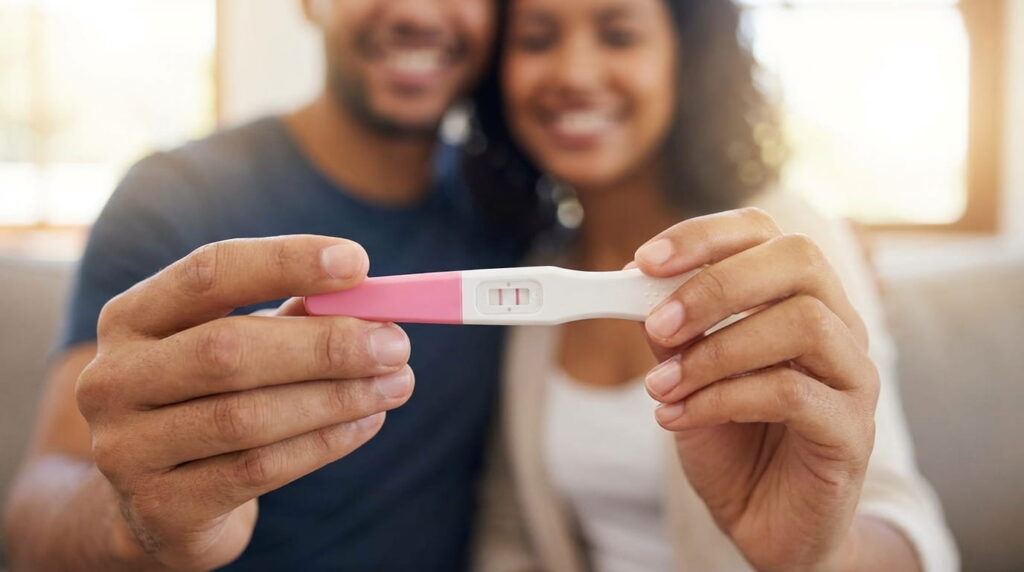
After In Vitro Fertilization with donor eggs, the waiting period until the test is often the most emotionally charged part. At this stage, recommendations should remain realistic and simple: medication should be followed exactly as prescribed, and symptoms should be interpreted cautiously. Some symptoms may be caused by hormonal treatment, not necessarily by pregnancy.
For those who feel the need for a more personal perspective on the journey, the first reference I would make is to IVF – the patient experience.
Success chances and the factors that influence them
One reason why In Vitro Fertilization with donor eggs often has better chances than IVF with the patient’s own eggs is that the eggs usually come from young donors who have been medically evaluated, which reduces the risk of problems related to egg quality.
Still, In Vitro Fertilization with donor eggs is not “guaranteed”. In practice, the result is influenced by the condition of the uterus and the quality of the endometrium, by the recipient’s medical history, by the male factor and by the laboratory component. In some cases, a well-designed plan means allowing time for uterine optimization before repeating transfers, in order to avoid emotional strain and costs without a real increase in the chance of success.
For a broader presentation of the treatment stages and logic, an overview-style guide can be useful, and in this regard I have also included In Vitro Fertilization (IVF) – complete guide as a complementary resource.
Because the decision is sometimes also influenced by timing and eligibility, it is useful to know that there is also an administrative component for certain couples. In this regard, I have included the first reference to National IVF Program 2025, which may influence the steps and time intervals.
“You deserve to be heard, seen, treated with respect, and supported throughout your life.”

What to expect physically, emotionally and logistically
In In Vitro Fertilization with donor eggs, the recipient does not go through ovarian stimulation, but usually follows treatment for endometrial preparation. Side effects are generally tolerable and depend on the individual response to medication. It is important not to draw conclusions based only on symptoms during the waiting period, because these are nonspecific.
From a logistical perspective, In Vitro Fertilization with donor eggs may involve fewer visits than IVF with ovarian stimulation in the patient, but these are targeted visits for monitoring the endometrium, within a timeline that depends on synchronization. Sometimes, the waiting period until transfer may be longer than expected, and this should be understood as a natural part of optimization, not as a sign that something is “stuck”.
In discussions about planning and options, the question of fertility preservation and the right timing for cryopreservation sometimes also appears. As a complementary resource, I have included egg cryopreservation – what it is, how it is done and when it is recommended.
When severe pain, heavy bleeding, fever or a generally unwell condition appear, I recommend contacting the clinic without delay.
Risks and limitations
The risks in In Vitro Fertilization with donor eggs are not caused “by the donated eggs” themselves, but by the general risks of pregnancy, which depend mainly on the age and health status of the recipient, and by the risks related to the transfer strategy.
An important aspect is avoiding multiple pregnancy when it is not necessary. The decision regarding the number of embryos is made individually, depending on medical history and the safety objective, and the medical target remains, in general, a singleton pregnancy with the lowest possible risk.
Frequently Asked Questions
Who can usually benefit from In Vitro Fertilization with donor eggs?
Most often, patients with a very low ovarian reserve, ovarian insufficiency, early menopause or repeated failures with their own eggs. The indication is established after medical evaluation, not based on age alone.
Does the recipient still need ovarian stimulation?
In In Vitro Fertilization with donor eggs, the recipient does not need stimulation for ovulation because the eggs come from a donor. Instead, the focus is on preparing the endometrium with an appropriate protocol.
How long does the process usually take?
The duration varies depending on the donation program, synchronization and the transfer plan. Sometimes transfer can be reached within a relatively short time. In other cases, the timeline becomes longer if the endometrium requires optimization or if transfer is planned in a later cycle.
What are the chances of success with In Vitro Fertilization with donor eggs?
The chances are influenced by egg quality, which is generally good in donation programs, and by the uterine conditions of the recipient. There is no universal percentage that applies to all cases, and a realistic estimate is made based on medical history and uterine evaluation.
What happens if the first transfer does not lead to pregnancy?
A negative result does not automatically mean that In Vitro Fertilization with donor eggs cannot work. The next step is a methodical analysis of the stages, including embryo quality, endometrial preparation, transfer timing and any relevant uterine causes, followed by adjustment of the plan before repeating the transfer.
Are there greater pregnancy risks if the eggs are donated?
Pregnancy risk is influenced mainly by the age and health of the woman carrying the pregnancy, meaning the recipient, not by the fact that the eggs are donated. Proper monitoring remains important, especially when pre-existing risk factors are present.
Is it mandatory to transfer two embryos to increase the chance?
No. In many situations, transferring a single embryo is the safest and sufficient option. Multiple pregnancy increases obstetrical risks, which is why the decision is made individually.
What can the couple do to increase the chances before transfer?
Factors such as quitting smoking, correcting certain hormonal imbalances, for example thyroid-related ones, treating diagnosed infections and controlling weight where appropriate can be optimized. The most important element remains a correct and consistent medical plan with proper monitoring before transfer.

The role of Dr. Andreas Vythoulkas in In Vitro Fertilization with donor eggs
In In Vitro Fertilization with donor eggs, my role is not only to indicate a procedure, but to build a coherent and safe plan, from the initial evaluation to interpreting the outcome and defining the next steps. I begin by clarifying why this option is recommended and what I am trying to solve medically through it: a severe ovarian factor, repeated failures or a situation in which the patient’s own eggs no longer offer a reasonable probability of success.
Then, the focus shifts to the recipient: the uterus, the endometrium and the factors that may reduce implantation. In In Vitro Fertilization with donor eggs, the details of endometrial preparation and timing make the difference between a transfer performed “according to the calendar” and one performed within the correct implantation window.
At the same time, communication is essential. For many couples, the decision to pursue In Vitro Fertilization with donor eggs carries a particular emotional burden, and the goal is for the choice to be informed, without pressure, with realistic expectations and clear steps.
Talk to me about
In Vitro Fertilization with Donor Eggs

Sources
Similar Articles

What Changes in Fertility During Perimenopause and What Should Not Be Assumed Automatically

Embryo Grading