

When I discuss a pregnancy without embryo, the first thing I do is reduce the anxiety created by short and cold formulations in an ultrasound result. I often tell patients that such a diagnosis must be properly understood, confirmed with caution and integrated into the full context of the pregnancy, symptoms and medical history. In my practice, I never start with urgency, but with clarity: what has been seen, what has not yet been seen and what the next reasonable step is. For many patients who have already gone through fertility evaluations or In Vitro Fertilization (IVF), this explanation is even more important, because the emotional impact is often greater.
A pregnancy without embryo does not mean that the patient did something wrong and is not, in general, the result of effort, strong emotion or an ordinary action from daily life. In most situations, we are discussing a very early form of pregnancy loss, and the cause is frequently related to chromosomal abnormalities that appear randomly during early pregnancy development.
What a pregnancy without embryo actually means
When I use the expression pregnancy without embryo, I refer to the situation in which the ultrasound shows the gestational sac, but without identifying the embryo inside. In medical language, this situation may also be referred to as an anembryonic pregnancy. I explain to patients that the body has started the pregnancy process, but embryonic development stopped very early or did not progress as it normally would.
It is important to make a clear distinction: not every gestational sac without a visible embryo on a very early ultrasound automatically means a pregnancy without embryo. Sometimes, the pregnancy is simply too small to allow visualization of embryonic structures. This is why I insist that we should not turn a suspicion into a definitive diagnosis after a single ultrasound performed too early.
In my clinical experience, pregnancy without embryo is one of those situations where the way we communicate matters greatly. The patient needs to understand what is visible, what is not yet visible and why I sometimes recommend waiting a few days before reaching a final conclusion.
How I confirm the diagnosis and why I avoid rushed conclusions
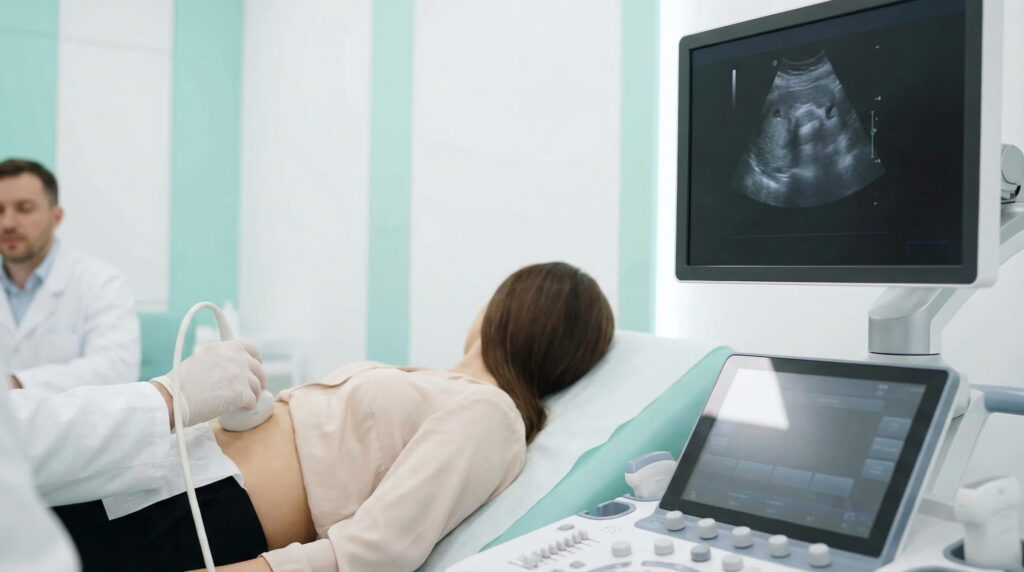
The diagnosis of pregnancy without embryo must be confirmed by ultrasound, and the correct standard is caution. I do not consider it appropriate to assign a definitive label when the ovulation date is uncertain, cycles are irregular or the ultrasound was performed very early. In such cases, a short-interval reassessment is often more useful than a rushed conclusion.
During the ultrasound, I follow:
- the estimated gestational age
- the size of the gestational sac
- the presence or absence of the yolk sac
- the possible embryonic pole
- correlation with clinical history
I never rely on a single isolated element. I try to put together the ultrasound image, symptoms, beta-hCG dynamics when relevant and the probable dating of the pregnancy.
I often tell patients that repeating the ultrasound does not mean lack of decision, but medical care. If there is a possibility that the pregnancy is smaller than expected, reevaluation in 7–14 days can make the diagnosis much more reliable. In my practice, I prefer rigorous confirmation before any therapeutic recommendation, especially when we are dealing with a desired pregnancy or one obtained after fertility treatments.
In short, at this stage I focus on a few essential aspects:
- avoiding a diagnosis made too early
- correlating ultrasound findings with the patient’s history
- differentiating a pregnancy without embryo from a very early evolving pregnancy
- choosing the correct timing for the next evaluation
Why a pregnancy without embryo occurs and what I explain about causes
In the consultation room, one of the most difficult questions is: “Why did this happen?”. My answer is usually calm and direct: in most cases, the cause is not related to something the patient did or did not do. Most very early pregnancy losses are associated with chromosomal abnormalities of the conception product, which occur spontaneously. This is also the most common explanation for a pregnancy without embryo.
I consider it important to also say what we do not always know. A single pregnancy without embryo does not automatically justify an extensive list of complex investigations. However, if there are recurrent pregnancy losses, then the approach changes and a broader evaluation may become useful, including genetic, uterine or endocrine factors.
In certain situations, if the patient’s history suggests associated issues, I expand the analysis. For example, in patients with pelvic pain, very painful menstruation or known infertility, it makes sense to also discuss symptoms of endometriosis. Sometimes the fertility picture is more complex, and the evaluation should not be reduced to a single episode.
I often explain a few key ideas:
- a pregnancy without embryo usually occurs due to early biological causes
- it is not typically the result of normal physical effort
- it should not automatically be interpreted as a sign that a future pregnancy will not occur
- it requires contextual interpretation, not rapid emotional conclusions
What symptoms may appear and when rapid evaluation is needed
A pregnancy without embryo may be discovered incidentally during a routine ultrasound, without obvious symptoms. In other cases, vaginal bleeding, cramps or a reduction in pregnancy symptoms may occur. It is important to understand that the absence of symptoms does not exclude the condition, just as the presence of bleeding does not automatically indicate the same diagnosis.
I advise patients not to delay evaluation if bleeding becomes heavy, if intense pain occurs, or if there is dizziness, fainting or general deterioration. In such situations, differentiating between an ongoing miscarriage, a missed miscarriage and an ectopic pregnancy becomes essential.
Signs that require rapid evaluation include:
- heavy vaginal bleeding
- intense or worsening pelvic pain
- marked weakness, dizziness or fainting
- significant unilateral pain
- fever or altered general condition
“You deserve to be listened to, seen, treated with respect and supported throughout life.”


What steps follow after confirmation

Once the diagnosis is correctly confirmed, I discuss options in a clear and minimally traumatic way. There is no single option suitable for all patients. The choice depends on clinical condition, bleeding intensity, patient preferences, medical history and emotional context.
In some cases, I may recommend expectant management, meaning a period of waiting for spontaneous elimination of pregnancy tissue. This approach may be reasonable if the patient is stable, has no significant pain and understands the warning signs that require prompt reassessment.
A second option is medical treatment, used to facilitate uterine evacuation. When I recommend this approach, I discuss openly about effectiveness, pain, bleeding and the need for follow-up. I explain that this option can avoid surgery in many cases, but requires monitoring and realistic expectations.
Surgical treatment is considered when there is significant bleeding, clinical risk, failure of other options or when the patient prefers a faster resolution. In such cases, I discuss indication, benefits, limitations and recovery. I do not present surgery as universally better, but as one of the legitimate options suited to certain situations.
When explaining next steps, I structure the decision clearly:
- first confirm the diagnosis
- then assess clinical condition and safety
- then discuss real management options
- finally establish follow-up and monitoring
For patients who wish to attempt conception again, I reassess the optimal timing and next steps. If the pregnancy occurred in the context of infertility, a broader discussion about IVF may become useful at a later stage, without rushing unnecessarily into procedures.
What investigations make sense after a pregnancy without embryo and when we move forward
After a single episode of pregnancy without embryo, I do not consider it necessary to automatically initiate an extensive testing protocol. In most cases, I recommend physical and emotional recovery, ultrasound reassessment if needed and a discussion about the appropriate timing for another attempt. In many situations, the prognosis for a future pregnancy remains good.
However, if there are recurrent losses, advanced reproductive age, infertility history, repeated implantation failure or specific suspicions, I recommend targeted investigation. This may include evaluation of the uterine cavity, endocrine factors and sometimes genetic counseling.
In assisted reproduction contexts, screening for aneuploidy (PGT-A) may be discussed, but not recommended for all patients, only when the medical history justifies it.
When associated gynecological pathology exists, such as endometriosis, I redirect the plan toward the underlying condition. Sometimes, understanding the overall reproductive context is more important than seeking simplified answers for a single episode.
Frequently Asked Questions
Is a pregnancy without embryo the same as a miscarriage?
In practice, I consider it part of the spectrum of early pregnancy loss. The difference is that the term more precisely describes the ultrasound finding: the gestational sac is present, but the embryo is not visible or has not developed properly.
Can the diagnosis be made too early?
Yes. This is why I recommend caution, especially when ovulation timing is uncertain or the ultrasound is very early. Sometimes what initially appears as a pregnancy without embryo only requires reevaluation after a few days.
Did I do something wrong if this happened?
In most cases, no. These situations are usually linked to spontaneous chromosomal abnormalities, not to effort, travel, emotion or normal activities.
Can I still have a normal pregnancy afterward?
Yes, in many cases. A single episode does not automatically indicate a poor prognosis.
Is curettage necessary in all cases?
No. Depending on the situation, options include expectant management, medical treatment or surgical treatment. The choice is individualized.
How long should we wait before trying again?
There is no universal answer. It depends on how the episode resolved, physical recovery, emotional state and whether further investigations are needed.
Are genetic tests necessary after this?
Not always. After a single episode, extensive genetic testing is not routinely indicated. It may be considered in cases of recurrent loss or specific clinical contexts.
Can this happen after IVF?
Yes. Even with IVF, early developmental abnormalities can occur. In such cases, context analysis becomes even more important.

The role of Dr. Andreas Vythoulkas in evaluating a pregnancy without embryo
In evaluating a pregnancy without embryo, my role is not only to confirm an ultrasound result, but to build a medical and human framework in which the patient understands exactly where she stands. I consider it essential to avoid premature labeling, correlate imaging with clinical data and clearly explain the difference between suspicion and confirmed diagnosis.
After confirmation, I work with the patient to choose the most appropriate management option. At the same time, I focus not only on closing the current episode, but also on what follows: when to resume attempts, whether additional investigations are needed and how to avoid rushed decisions in the future.
From my clinical experience, patients need calm explanations, medical logic and a clear plan. This is also my role: to clarify the diagnosis, recommend meaningful investigations, avoid unnecessary excess and guide the case appropriately, whether toward simple monitoring or further evaluation of fertility, uterine or genetic factors when justified.
Talk to Me About
Pregnancy Without an Embryo

Sources
Similar Articles

Sonohysterography (Sono-HSG): When I Recommend It, How Much It Costs and What We Do After the Result

Why Embryo Transfer Is Sometimes Not Performed in the Same Cycle
