

When you receive an oncology diagnosis, many questions suddenly stand in front of you: about treatment, prognosis, and life after. For some patients, another deeply personal question appears—sometimes hard to say at the first appointment: “Will I still be able to have children?” This is where oncofertility comes in: the field focused on protecting reproductive potential before cancer treatments affect the ovaries, testes, or reproductive function.
In my practice, I often see the same reality: time feels compressed and decisions must be made quickly. The good news is that, in many cases, there are concrete options—and a plan can be organized efficiently, in close collaboration with your oncologist. The purpose of this article is to explain, in clear terms, what oncofertility means, when it’s worth discussing, and which fertility preservation methods are most commonly used for women and men.
What “oncofertility” means (and when we use the term)
By oncofertility, we mean assessing fertility-related risks and applying fertility preservation methods before (or sometimes within the context of) cancer treatments. The term “oncofertility” is sometimes used as a synonym; in Romanian, “fertilitatea oncologică” captures the concept well, and I use it as my primary phrasing.
Beyond terminology, the practical message is this: before chemotherapy, radiotherapy, or certain surgeries begin, it’s worth having a clear conversation about the potential impact on fertility and the options that can be implemented in time.
How cancer treatments can affect fertility

The impact depends on the type of cancer, the treatment regimen, dose, age, and ovarian reserve or semen quality before treatment. In oncofertility, we don’t speak in absolute “yes/no” terms, but in probabilities—and how we can improve them.
Chemotherapy
Some medications affect rapidly dividing cells. For this reason, ovaries and testes may be vulnerable, and the risk can range from a temporary decrease in fertility to ovarian insufficiency or a significant reduction in spermatogenesis.
Radiotherapy
Risk depends heavily on the irradiated area and dose. Pelvic radiotherapy can affect the ovaries, uterus, or testes; radiotherapy in other regions may have indirect impact, depending on the protocol.
Surgical procedures
Some oncologic surgeries involve reproductive organs or nearby structures. In these situations, planning ahead makes a difference: if there is a window before surgery, we can consider preservation methods.
Hormonal or targeted therapies
In certain cancers, hormonal therapy may be long-term (months/years). Even if it doesn’t “destroy” fertility in the same direct way, it may delay when pregnancy can be attempted and requires a personalized strategy.
When the fertility preservation conversation should start
In oncofertility, ideally the discussion happens before the very first treatment. The earlier we establish the plan, the more options we have—and the more predictable they are.
Sometimes, time is very short. Even then, it does not automatically mean “nothing can be done.” There are protocols that can be adapted for urgent situations, and the method is chosen together with the oncology team, taking safety and timing into account.
Fertility preservation options for women in oncofertility

For female patients, the choice depends on age, ovarian reserve, the type of oncology treatment, and how much time exists before it begins. In some cases, one method is enough; in others, a logical combination may be useful.
Cryopreservation of eggs / embryos / ovarian tissue
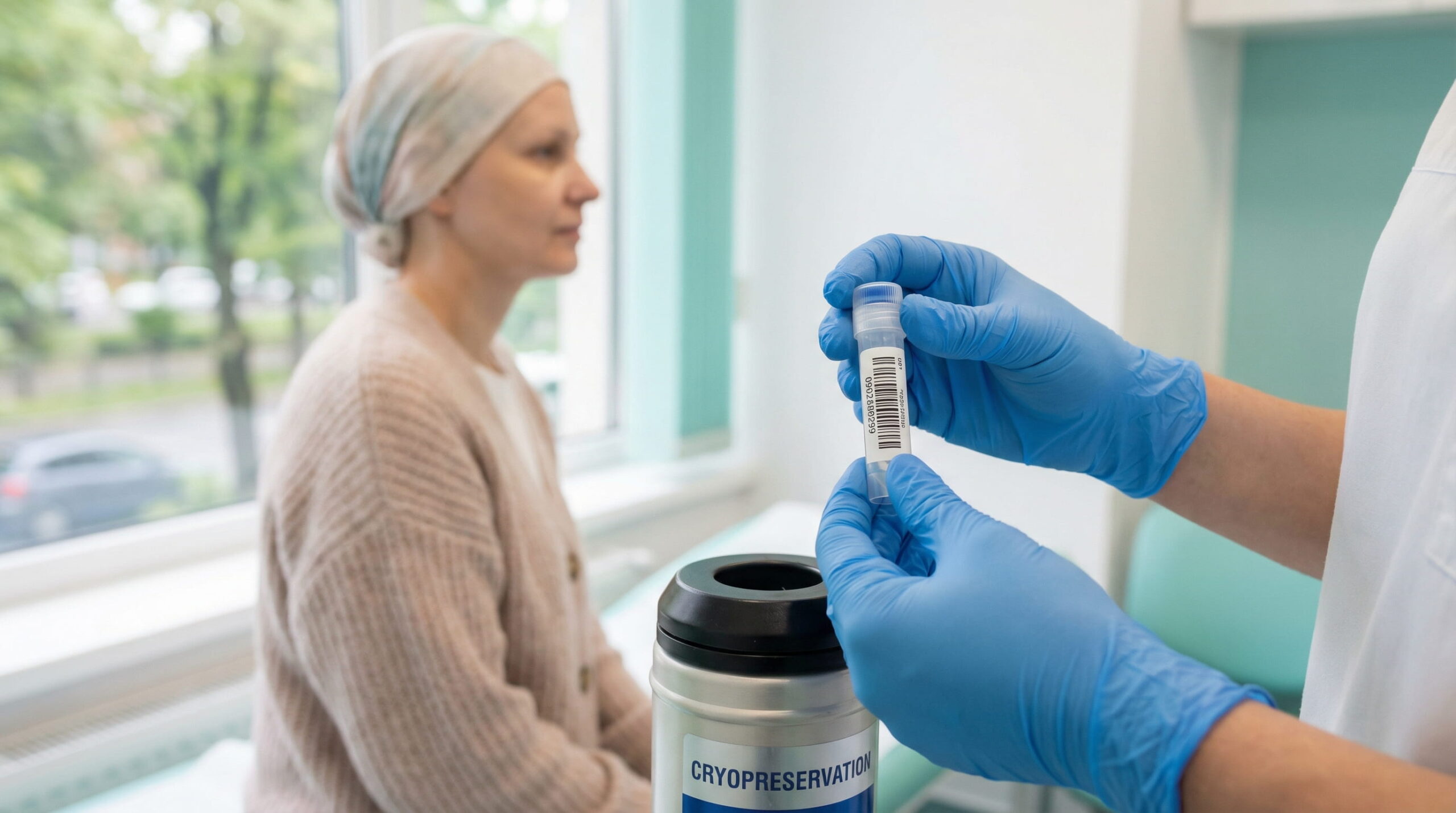
The best-known category of options remains cryopreservation of eggs, sperm, embryos, and ovarian tissue, with specifics depending on the situation:
- Egg freezing (oocyte cryopreservation): useful when preserving reproductive autonomy is important, without creating embryos at that moment.
- Embryo freezing: possible when there is a partner and creating embryos is appropriate for the patient.
- Ovarian tissue cryopreservation: may be considered in certain contexts (for example, when there isn’t time for ovarian stimulation or in special situations), but indications are discussed strictly on an individual basis.
In oncofertility, what matters greatly is the “time window” before oncology treatment. In many cases, retrieval can be organized within a realistic timeline without significant delays—but this is always decided together with the oncologist.
Ovarian transposition (before pelvic radiotherapy)
In certain situations, when the main risk comes from pelvic radiotherapy, we can discuss repositioning the ovaries outside the radiation field. It is not a universal solution and does not replace cryopreservation, but it can be one part of a coherent plan.
Medical ovarian protection
Sometimes medication aimed at ovarian protection during treatment is discussed. In practice, I treat it as a potentially complementary option in some cases, but not as an alternative that can replace preservation methods.
“You deserve to be listened to, seen, treated with respect and supported throughout your life.”

Fertility preservation options for men in oncofertility

For men, the most effective and fastest option is usually sperm cryopreservation (collection and freezing before treatment). It is relatively simple logistically, and the required time is most often short.
When standard collection is not possible, alternatives can be discussed (for example, surgical retrieval methods). Here, the plan depends on the context and on the time available before treatment.
Practical steps

When I work with oncology patients, I follow a clear pathway, because “fast” should not mean “rushed without logic.” Typically, the steps are:
- Initial consultation and review of the oncology context (diagnosis, treatment plan, urgency).
- Basic reproductive evaluation (depending on sex and clinical situation).
- Choosing the appropriate method and synchronizing with the oncologist.
- Implementing the plan (retrieval/cryopreservation, etc.).
- Follow-up plan and discussion about steps after treatment.
In situations where assisted reproduction is needed, In Vitro Fertilization (IVF) sometimes becomes part of the pathway—either later (after treatment is completed and the oncology “safety window” is confirmed), or as part of creating and freezing embryos, where appropriate.
For those who want to better understand the emotional and practical journey of a couple, I also detailed the perspective in IVF – the patient experience, with an emphasis on clarity and realistic expectations.
Safety questions
This is one of the most important themes. In oncofertility, we don’t “force” anything, and we do not put fertility in competition with cancer treatment. The right question is: “Can this be done safely and in time for this specific case?”
In many situations, protocols can be adapted so that any delay is minimal or negligible. In other situations, oncology urgency or risk means we choose a different option—or we avoid certain pathways. The decision is always made as a team with the oncologist, based on the patient’s medical data.
In hormone-dependent cancers (such as breast cancer), the strategy may require extra attention. Here, an individualized approach and close collaboration with the oncologist are essential.
Chances of success and what influences prognosis
There is no single “perfect number” that applies to everyone. In oncofertility, I discuss chances in a realistic, constructive way, based on concrete factors:
- Age and ovarian reserve (in women) or semen quality (in men).
- Type and intensity of oncology treatment.
- Chosen method and the results obtained at retrieval (number and quality).
- Time available before treatment begins.
My aim is to set clear expectations and build a plan that maximizes chances without compromising oncology safety.
Pregnancy after cancer: when it can be attempted and what monitoring is needed

The timing for attempting pregnancy after oncology treatment is set together with the oncologist, depending on the type of cancer, treatment, disease course, and recurrence risk. Sometimes, a waiting period is recommended; other times, the decision depends on periodic evaluations.
If pregnancy occurs, monitoring may be adapted—both obstetrically and in terms of oncology follow-up. What matters is a coordinated medical framework and communication between specialties.
Frequently Asked Questions
What is oncofertility?
Oncofertility is the field that assesses fertility risk and provides methods to preserve the chance of having biological children before cancer treatments affect reproductive function. It includes solutions for women and men, planned together with the oncologist.
When should fertility preservation be discussed?
Ideally before the first oncology treatment. Even when time is short, a rapid discussion is worth it, because in some situations there are solutions that can be adapted to urgency.
Does egg freezing mean I will definitely be able to have children later?
Cryopreservation improves chances, but it cannot provide guarantees. The outcome depends on age, the number and quality of eggs, oncology treatment, and the steps taken afterward. From the start, I discuss scenarios and probabilities realistically—without promises.
What is the difference between freezing eggs and freezing embryos?
Egg freezing preserves unfertilized eggs, and the fertilization decision is made later. Embryo freezing involves fertilizing eggs before freezing and usually implies a partner and a clear present-time decision. The choice depends on medical and personal context.
What options exist for men?
In most cases, sperm cryopreservation before treatment is the main option. It is relatively fast and useful for preserving future reproductive potential. If standard collection isn’t possible, alternatives can be discussed depending on the situation.
Do these procedures delay cancer treatment?
In many cases, the plan can be organized so that any delay is minimal. Still, it depends on oncology urgency and the proposed protocol. I do not recommend any step that could compromise oncology safety; coordination with the oncologist is essential.
Does menstruation returning after treatment mean fertility has returned?
Not necessarily. The return of menstruation can be a good sign, but it doesn’t automatically equal a normal ovarian reserve or preserved fertility. Assessment is done with blood tests and ultrasound, depending on age and treatment history.
If I already have cryopreserved embryos/eggs, when can pregnancy be attempted?
Timing depends on the oncologist’s recommendation and disease course. Sometimes there is a waiting period; other times the decision is made based on periodic follow-up. I plan reproductive steps only after the oncology framework is clear and safe.

Dr. Andreas Vythoulkas’ role in oncofertility
In oncofertility, my role is to turn an extremely emotionally loaded period into a coherent medical plan—one you can understand and decide on with full information. I don’t work “in parallel” with oncology, but together with your oncologist: synchronization and safety come first.
I handle reproductive evaluation, explain options in clear language, and organize the steps quickly in a way that fits your case. Where needed, I integrate assisted reproduction, and when the discussion includes a broader institutional and logistical framework, collaboration with Genesis Athens teams can be part of the pathway—through options such as cryopreservation of eggs, sperm, embryos, and ovarian tissue and, later, In Vitro Fertilization (IVF), whenever the medical plan indicates this.
If I had to summarize it in a few words: in oncofertility, I aim for you to have a clear, fast, and safe strategy—without losing sight of the primary goal (cancer treatment) and without unnecessarily giving up your chance to preserve reproductive options for the future.
Talk with me about
Oncofertility
Sources
- ASCO – Fertility Preservation in People With Cancer (Guideline Update)
- ESMO – Fertility preservation and post-treatment pregnancies (Clinical Practice Guideline)
- ESHRE – Guideline: Female fertility preservation
- ASRM – Committee Opinion: Fertility preservation in patients undergoing gonadotoxic therapy or gonadectomy
- National Cancer Institute (NCI) – Female Fertility and Cancer Treatment
Similar Articles

IVF Psychological Counselling | Essential Support

Can You Get Pregnant With One Fallopian Tube?