


In fertility evaluation, there are a few investigations that can decisively change the treatment plan. Hysteroscopy is one of them, because it allows me to see the uterine cavity directly and, in certain situations, to correct on the spot problems that can affect implantation or the course of a pregnancy.
When I talk about “hysteroscopy” (and sometimes “hysteroscopy in infertility”), I mean a minimally invasive procedure performed through the natural route (through the cervix), without incisions, which can be purely diagnostic or can become therapeutic when there is something worth treating.
What hysteroscopy is, in plain terms
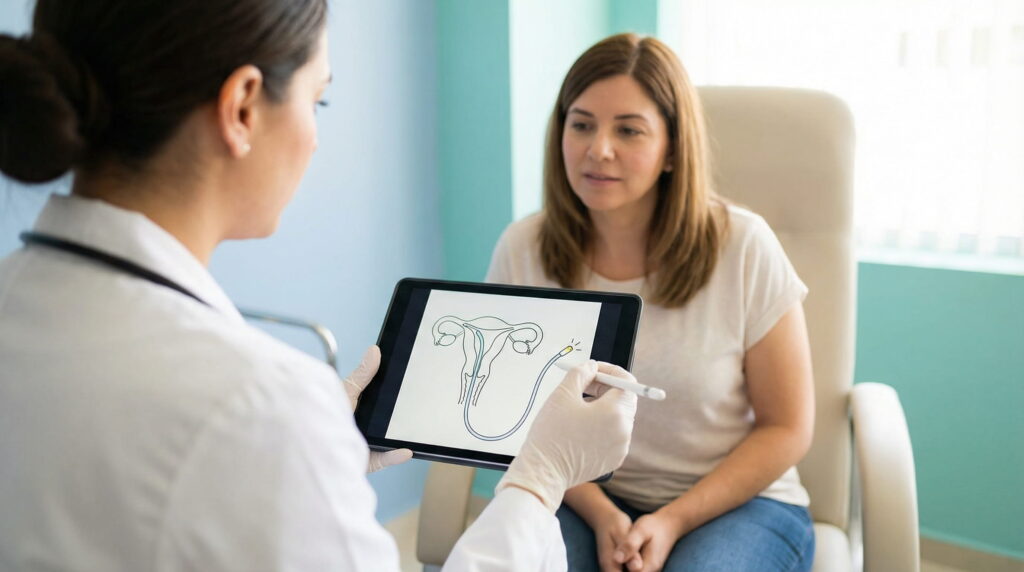
Hysteroscopy is an exploration of the uterine cavity using a thin instrument with a camera, which provides a real image of the endometrium and the shape of the cavity. The key difference from ultrasound is that here I don’t “infer”—I see directly.
In practice, I encounter two forms:
- Diagnostic hysteroscopy: the goal is to identify exactly what is happening inside the uterus.
- Operative hysteroscopy: in addition to diagnosis, I can remove a polyp, treat adhesions, or correct certain changes, when indicated and safe.
Why hysteroscopy matters in infertility

In infertility, any detail related to the uterine cavity can matter. Implantation needs a “clean,” functional space, and some problems are small in size but large in impact.
Hysteroscopy helps me identify (and sometimes treat) situations such as:
- endometrial polyps;
- submucosal fibroids (those that distort the cavity);
- intrauterine adhesions (synechiae);
- uterine septum or anatomical variations;
- findings suggestive of endometrial inflammation (discussed cautiously, in the context of symptoms and history).
This is where the nuance “hysteroscopy in infertility” often comes in—not because it is “mandatory for everyone,” but because in certain patient profiles it brings clarity and can prevent steps taken “based on assumptions.”
When I recommend hysteroscopy
I recommend hysteroscopy when I need a clear answer about the uterine cavity before choosing the next step. Most often, the indication appears in these contexts:
- ultrasound raises suspicions (polyp, submucosal fibroid, endometrial irregularities);
- abnormal uterine bleeding, especially if recurrent;
- unexplained infertility after basic evaluation;
- recurrent pregnancy loss (within a coherent investigation plan);
- before or after repeated unsuccessful attempts, including in the context of In Vitro Fertilization (IVF), when I want to ensure the uterine environment is optimal.
When in the menstrual cycle hysteroscopy is performed
In most cases, I prefer hysteroscopy in the first part of the cycle, after menstruation ends. The reason is simple: the endometrium is thinner and visibility is better, which increases diagnostic accuracy.
If there is irregular bleeding or a special context (for example, an urgent treatment timeline), I personalize the timing. I don’t treat “by the calendar,” but by the clinical objective.
How hysteroscopy is performed

Typically, the procedure has clear steps: recommendation and full explanation, preparation, exploration of the uterine cavity, and then (only if needed) the therapeutic step.
During hysteroscopy, I introduce the instrument through the cervix and visualize the cavity on a monitor. If I discover a polyp or another clear lesion and there is an indication, I can proceed to treatment in the same session (depending on the planned procedure type and safety conditions).
Preparing for hysteroscopy
I want patients to arrive with correct expectations: preparation is usually simple, but it must be done responsibly. Depending on the case, common recommendations may include:
- excluding pregnancy (if needed, a pregnancy test);
- general blood tests if the procedure is planned with sedation/anesthesia;
- assessment for vaginal/cervical infections if there are symptoms;
- discussion about medication (especially anticoagulants or antiplatelets);
- if sedation/anesthesia is planned, fasting according to the provided instructions.
In some infertility plans, preparation runs in parallel with hormonal testing, so we don’t lose time and we build the complete picture.
Pain and anesthesia: what to expect
Experience varies, but in general, diagnostic hysteroscopy can be well tolerated, with discomfort comparable to menstrual cramps. For operative hysteroscopy—or when we anticipate more discomfort—I choose the appropriate sedation or anesthesia.
My goal is the same: a safe procedure, good pain control, and an experience that is as predictable as possible for the patient.
Risks and (rare) complications, in brief
Hysteroscopy has a good safety profile, but like any procedure, it carries risks. The most discussed are bleeding, infection, reactions to medication/anesthesia, and very rarely, uterine perforation.
Signs for which I prefer to be contacted as soon as possible after the procedure:
- foul-smelling discharge;
- fever;
- pain that increases and does not respond to usual painkillers;
- heavy bleeding.
“You deserve to be listened to, seen, treated with respect and supported throughout your life.”


Recovery after hysteroscopy
Most of the time, recovery is quick. Mild cramps and light bleeding for 1–3 days can occur. Normal activities can usually be resumed quickly, and recommendations about effort, sexual intercourse, or using intravaginal tampons are tailored based on the procedure type and what was actually done.
Hysteroscopy and IVF

When I prepare an IVF plan, I aim to reduce uncertainty. A correctly evaluated uterine cavity can mean an embryo transfer performed with more confidence—without the lingering question of “whether there was something in the uterus.”
At the same time, the patient experience matters enormously in this journey, including how we communicate the steps and why we do them. That is why the perspective from the IVF patient experience aligns well with my philosophy: clarity, predictability, and medically explained decisions.
At an institutional level, this same integration of hysteroscopy into the fertility pathway is also reflected in how hysteroscopy at Genesis Athens is presented—as part of a complete plan, not as an isolated procedure.
Investigations that complement hysteroscopy
Hysteroscopy answers the question, “What does the inside of the uterine cavity look like?” Other investigations answer other questions: ovulation, ovarian reserve, tubes, endometriosis, and so on.
For example, a hormonal profile remains essential in many situations, and the institutional approach to hormonal testing is helpful when we build a complete evaluation. And when we discuss assisted reproduction steps, the IVF framework provides a coherent picture of stages and options.
Frequently Asked Questions
Is hysteroscopy painful?
Usually, discomfort is moderate and similar to menstrual cramps. For many patients, diagnostic hysteroscopy is tolerable. If I anticipate more pain or we perform operative steps, we choose appropriate sedation/anesthesia.
How long does hysteroscopy take?
The procedure itself is usually short: a few minutes for the diagnostic form, while the operative form can take longer, depending on what we treat. With preparation and monitoring, the time spent in the clinic is longer than the “hands-on” time.
Can I have hysteroscopy without anesthesia?
Yes—many diagnostic hysteroscopies can be done without anesthesia. The decision depends on your tolerance, anatomy, and the goal of the procedure. I prefer the option that preserves comfort without compromising exploration quality.
If the ultrasound is normal, is hysteroscopy still useful?
Sometimes, yes. Ultrasound is excellent, but it doesn’t always detect small intracavitary lesions or certain endometrial details. If your history suggests a cavity issue, hysteroscopy can provide the clear answer.
Can polyps be removed in the same session?
Yes, if the procedure is planned as an operative hysteroscopy and the lesion is suitable for safe treatment. If the finding occurs during a strictly diagnostic hysteroscopy, I may recommend a second step under optimal conditions.
When can I try to get pregnant after hysteroscopy?
After diagnostic hysteroscopy, the plan can often resume quickly. After an operative procedure, timing depends on what we treated and how the endometrium looks at follow-up. I usually set a realistic and safe interval—without unnecessary rushing.
Is there a risk of long-term uterine damage?
Serious complications are rare. With correct indication, technique, and monitoring, hysteroscopy has a good safety profile. That is why I insist on proper case selection and a full benefits-versus-risks explanation.
What is normal after hysteroscopy—and what isn’t?
It’s normal to have mild cramps and light bleeding for a few days. Fever, severe worsening pain, or heavy bleeding are not normal—if these occur, I prefer to be informed as soon as possible.

Dr. Andreas Vythoulkas’ role in hysteroscopy
In my practice, I don’t treat hysteroscopy as an “extra procedure,” but as a precise clinical decision: I recommend it when it can provide information that changes the plan or when it can correct a problem with a real impact on fertility. I want every patient to understand why I propose it, what I’m looking for, and what the alternative is if we don’t do it.
I focus on choosing the right type of hysteroscopy (diagnostic vs. operative), on comfort control, and on integrating the findings into the next steps. When an intervention is needed, my goal is for it to be done completely, safely, and with a clear recovery plan—so that no “grey areas” remain in the evaluation.
Most importantly, I keep the conversation grounded in reality: what hysteroscopy can solve, what it cannot solve, and what the next step looks like in practical terms. In infertility, this clarity reduces stress and improves medical decision-making.
Talk with me about
hysteroscopy

Sources
- NHS (UK) – Hysteroscopy
- NHS inform (Scotland) – Hysteroscopy
- RCOG (Royal College of Obstetricians and Gynaecologists) – Outpatient hysteroscopy
- ASRM (ReproductiveFacts.org) – Evaluation of the Uterus (includes hysteroscopy)
- MedlinePlus (U.S. National Library of Medicine) – Hysteroscopy (Medical Test)
Similar Articles

In Vitro Fertilisation (IVF) | The Patient Experience

Is Unblocking the Fallopian Tubes Worth It for Getting Pregnant?
