

When we talk about fertility, hormone tests are often the first thing couples ask for. It’s understandable: a result “outside the reference range” can feel like a quick answer. In reality, fertility hormone tests are only useful if they’re chosen correctly, collected at the right time, and interpreted in the context of the menstrual cycle, ultrasound findings, and medical history.
In my practice, I often see two situations that create confusion: either a “standard panel” is done without considering cycle day, or firm conclusions are drawn based on a single hormone. Below is a clear guide to fertility hormone tests: which tests are worth doing, when the timing matters, what a result may mean, and what the next steps usually are.
Why hormone tests matter in fertility evaluation
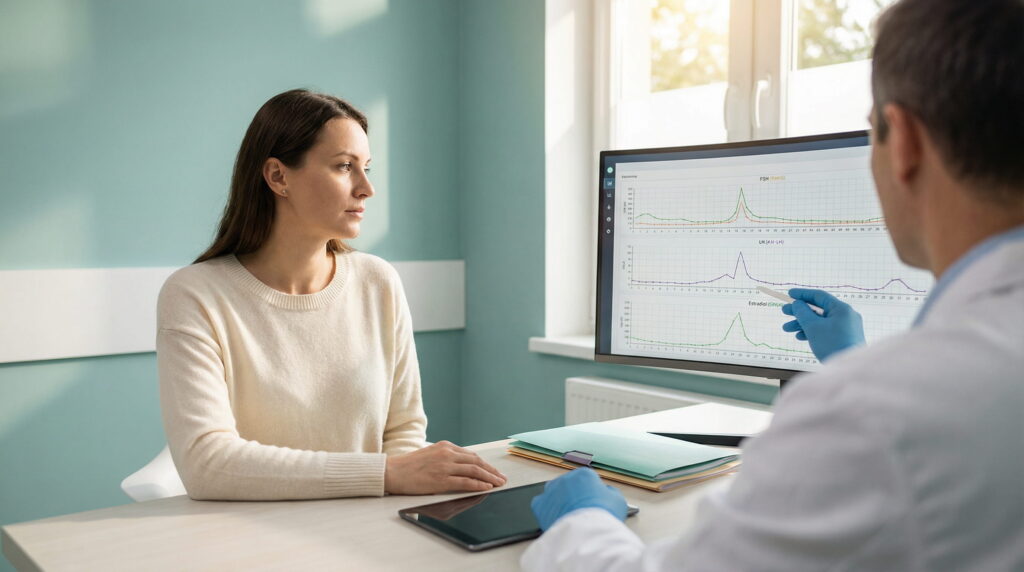
Hormones coordinate ovulation, endometrial preparation for implantation, and— in men—processes that support sperm production. Still, a single result rarely “tells the whole story.” For example, low AMH may suggest a lower ovarian reserve, but it does not automatically tell us whether ovulation is happening monthly or how quickly pregnancy may occur. Similarly, elevated TSH can influence fertility and pregnancy outcomes, but its exact significance depends on context and the rest of the evaluation.
Hormone tests become truly valuable when we use them as an orientation tool: they can show whether there’s a treatable problem (for example thyroid dysfunction or hyperprolactinemia), whether additional testing is needed (ultrasound, ovulation tracking, semen analysis), or whether a tailored treatment plan is recommended. This is the real meaning of “hormone testing in fertility”: not a checklist, but a clinical decision.
When it makes sense to do fertility hormone tests
In general, I recommend hormonal evaluation when cycles are irregular, absent, or unpredictable; when there are signs suggesting anovulation (rare ovulation); or when symptoms point to endocrine issues (thyroid, prolactin). Hormone testing is also useful when PCOS is suspected, when treatments have not worked, or when we are preparing a treatment plan.
If an In Vitro Fertilization (IVF) plan is being prepared, fertility hormone tests are essential to choose the best strategy and to anticipate ovarian response.
As a general timing reference, if you’ve been trying for 12 months without success (or 6 months if age is higher), it’s reasonable to move to a full evaluation. But if cycles are irregular or there are obvious signs of a hormonal problem, there’s no reason to wait.
Blood test timing: why cycle day matters a lot
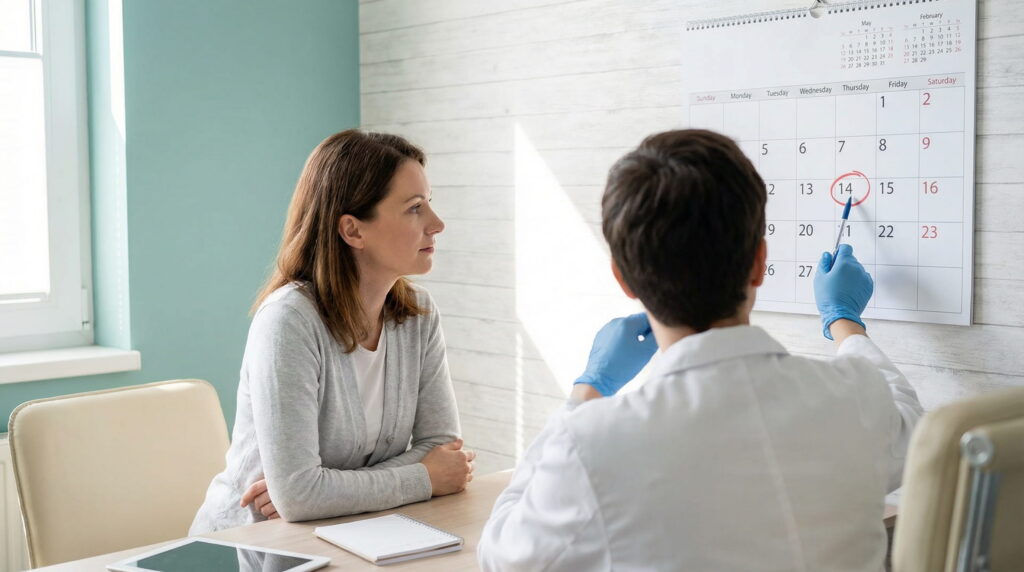
One of the most common reasons for hard-to-interpret results is collecting tests on the wrong day. For FSH, LH, and estradiol (E2) in particular, cycle day changes the meaning significantly. And for progesterone, “day 21” is not a universal rule.
Cycle day 2–4 (early follicular phase)
During this window, we can more accurately assess the hormonal “baseline” of the cycle. Typically useful tests include:
- FSH
- LH
- estradiol (E2)
These help us understand how the cycle starts and how the ovaries respond to hormonal signals. For fertility hormone testing, this is one of the most important timing anchors.
Progesterone: confirming ovulation, not a “routine test”
Progesterone is useful when we want to confirm ovulation and assess luteal phase adequacy. The correct timing is usually about 7 days after ovulation (not a fixed calendar day for everyone). If you have a 28-day cycle with ovulation around day 14, testing around day 21 can be appropriate. If ovulation is later—or the cycle length differs—the testing day changes as well.
Tests that can be done any day (with nuances)
Some hormones are less dependent on cycle day, but context still matters:
- AMH (can be collected any day, but interpretation depends on age and ultrasound)
- TSH (and, when needed, FT4 / thyroid antibodies)
- prolactin (ideally morning, at rest, without stress/exertion beforehand)
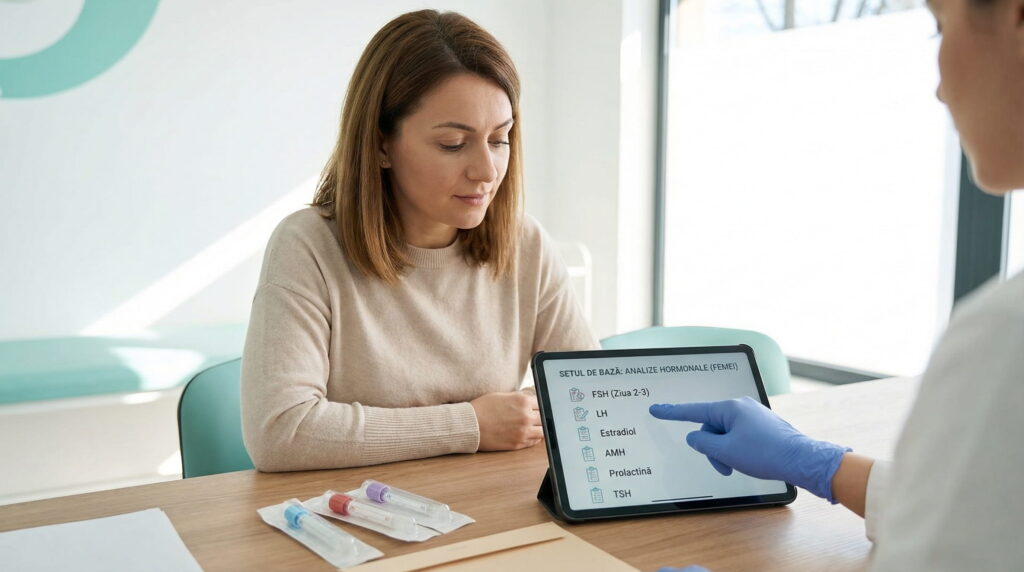
The core panel: hormone tests commonly recommended in fertility (women)
There is no single “perfect package” for everyone, but there is a core set that most often provides useful information. When we talk about hormone testing in fertility, I prefer to start with what can change medical decisions, and then add tests only if there is a clear indication.
AMH (anti-Müllerian hormone): ovarian reserve
AMH is an indicator of ovarian reserve, meaning the estimated number of available follicles. It does not “diagnose infertility,” but it helps us anticipate response to stimulation and choose an appropriate strategy. AMH should be interpreted together with ultrasound (antral follicle count) and age.
FSH + estradiol (E2): the early-cycle picture
FSH and E2 collected on cycle days 2–4 can suggest how the cycle “starts” and whether there are indirect signs of reduced ovarian reserve. Sometimes higher estradiol can “mask” an FSH that would otherwise look higher—so it’s useful to evaluate them together.
LH: especially useful when anovulation/PCOS is suspected
LH can be relevant when cycles are irregular and we suspect infrequent ovulation. I don’t interpret LH in isolation—always alongside symptoms, ultrasound, and other results.
Progesterone: ovulation confirmation
Progesterone, done at the correct time, can tell us whether ovulation occurred and whether the luteal phase is adequate. When it’s done too early or too late, it can create false impressions and complicate interpretation unnecessarily.
Prolactin: when it matters and how to collect it properly
Prolactin can rise transiently due to stress, poor sleep, exercise, or even anxiety around blood draws. That’s why I recommend morning collection, at rest, and sometimes repeating the test if it’s only mildly elevated. Persistently high values can affect ovulation.
TSH (and, when needed, FT4 / thyroid antibodies)
Thyroid function is linked to ovulation, implantation, and pregnancy progression. If there are symptoms, family history, known thyroiditis, or abnormal values, we expand testing and choose management based on the full context.
Hormone testing in fertility: when we also evaluate the male side
A point I like to emphasize early is that fertility is a “team sport.” Even though many hormone tests are associated with the woman, a male hormonal profile can be relevant in certain situations—especially if semen analysis is abnormal or if there are suggestive clinical signs.
In those cases, tests such as FSH, LH, testosterone (and sometimes SHBG) can be useful, plus prolactin and TSH depending on context. The goal isn’t to “tick boxes,” but to identify treatable causes and the most effective direction.
“You deserve to be listened to, seen, treated with respect and supported throughout your life.”

Special profiles: when a standard panel isn’t enough
Suspected PCOS or hyperandrogenism
If you have severe acne, excess hair growth, rare cycles, or ovulation that is hard to identify, we expand evaluation toward androgens (depending on the case) and correlate with ultrasound and metabolic markers. In these situations, fertility hormone testing is only truly useful when it’s well targeted.
Cycle disorders (amenorrhea / very rare periods)
Here, we try to distinguish whether we’re dealing with a hypothalamic cause (stress, weight loss, intense exercise), an ovarian cause, or an endocrine cause (thyroid, prolactin). The order of testing and interpretation is the difference between a correct conclusion and an early, misleading label.
Endometriosis: the role of hormones and their limits
In endometriosis, hormone tests don’t establish the diagnosis, but they can be relevant for treatment planning and fertility strategy. Depending on symptoms and evaluation, we sometimes discuss endometriosis treatment and how disease management aligns with fertility goals.
Common pitfalls in interpreting hormone tests
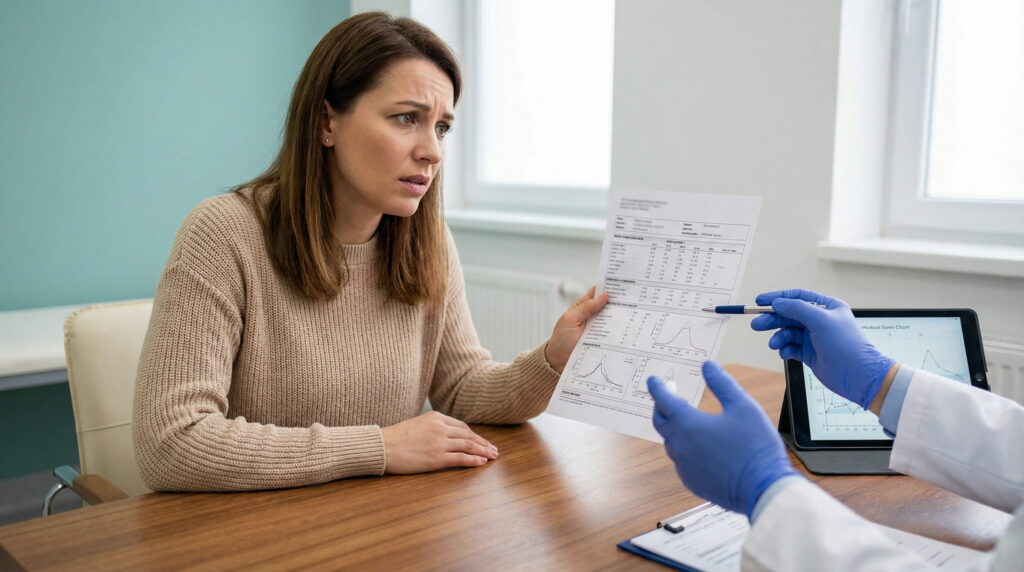
A result can look “abnormal” without reflecting a real problem—or the opposite. In my experience, the most frequent pitfalls are different reference ranges between labs, collecting on the wrong cycle day (especially for FSH/LH/E2 and progesterone), and transient influences like stress, infections, poor sleep, exercise, or certain supplements (for example biotin) and hormonal medications.
When there’s uncertainty, the solution is not anxiety—it’s repeating the right test at the right time and interpreting it together with the rest of the evaluation. In fertility hormone testing, context often matters more than the number.
What comes after the tests: practical next steps
After we have results, the right approach is to place them into a logical plan. Depending on the situation, next steps may include ovulation tracking, ultrasound, tubal evaluation, semen analysis, or treatments targeting the identified cause. If the profile suggests low ovarian reserve or if time is an important factor, we may also discuss options such as IVF within a medical plan tailored to the specific case.
Likewise, when endometriosis is suspected or diagnosed and we’re discussing fertility strategy, management may include information and options related to endometriosis treatment within a specialized framework—especially when symptoms or history suggest a significant impact on fertility.
Frequently Asked Questions
Which cycle day should fertility hormone tests be done?
It depends on the test. FSH, LH, and estradiol (E2) are usually collected on cycle days 2–4. Progesterone is collected about 7 days after ovulation. AMH can be done any day.
Can AMH be done anytime?
Yes, AMH can be collected on any cycle day. However, interpretation depends on age and ultrasound, not as an isolated value.
Is progesterone always tested on day 21?
No. “Day 21” only applies to 28-day cycles with ovulation around day 14. The correct timing is about 7 days after ovulation, regardless of which cycle day ovulation occurs.
If FSH is elevated, does that mean I can’t get pregnant?
Not necessarily. Elevated FSH can suggest lower ovarian reserve, but it doesn’t determine prognosis alone. Age, AMH, ultrasound, and ovulation status matter.
Does TSH affect fertility?
Yes. Thyroid function can affect ovulation and also influence pregnancy. If TSH is abnormal, evaluation is completed and management is chosen based on context.
Is mildly elevated prolactin a reason to worry?
Not automatically. Prolactin can rise transiently due to stress or lack of sleep. If it’s mildly elevated, I often recommend repeating it under proper conditions before drawing conclusions.
Which hormone tests can be useful for men as well?
Not all men need a hormonal profile. It becomes useful especially when semen analysis is abnormal or there are clinical suspicions. Depending on the case, we evaluate FSH, LH, testosterone, and sometimes prolactin and TSH.
If hormone tests are “normal,” does that rule out a fertility problem?
No. Normal hormone tests are reassuring, but fertility can still be influenced by other factors (tubes, endometrium, sperm quality, age, endometriosis, etc.). That’s why proper evaluation is comprehensive.
Dr. Andreas Vythoulkas’ role in hormone testing and fertility
Hormone tests are a tool—not a verdict. My role is to choose, together with you, the investigations that make sense in your specific case, ensure they are collected at the right time, and interpret results in the full context: your history, ultrasound, ovulation regularity, and time-related goals.
Instead of ordering “as many tests as possible,” I prefer a clear approach: we start with what can change medical decisions, and then add only investigations that bring real, actionable information. This helps avoid both unnecessary delays and anxiety caused by results taken out of context.
For me, “hormone tests in fertility” means, first and foremost, a coherent plan: what we test, why we test, when we test, and what we do with the result.
Talk with me about
Hormone Testing and Fertility

Sources
- ASRM – Testing and interpreting measures of ovarian reserve (AMH, FSH, E2)
- ASRM – Fertility evaluation of infertile women (committee opinion)
- Endocrine Society – Diagnosis and Treatment of Hyperprolactinemia (guideline)
- American Thyroid Association – Hypothyroidism in Pregnancy (TSH & recomandări)
- NCBI Bookshelf (Endotext) – Ovarian Reserve Testing (review)
Similar Articles

IVF Psychological Counselling | Essential Support

The Three H’s: Hysteroscopy, Hysterosonography, Hysterosalpingography
