

In my practice, I refer to frozen embryos when embryos obtained during an In Vitro Fertilization (IVF) cycle are cryopreserved and transferred in a later cycle. This option is part of a broader treatment plan, in which cryopreservation may play a central role, either for safety or for optimizing the timing of transfer.
Within the context of a complete IVF cycle, the decision between fresh transfer and frozen embryo transfer is made based on the clinical data of that specific cycle, not according to “fixed recipes.” For a structured overview of the stages, the reference point on In Vitro Fertilization (IVF) may be useful, because it clarifies the logic behind the steps and medical decisions.
What “frozen embryos” means and what the “freeze-all” strategy means

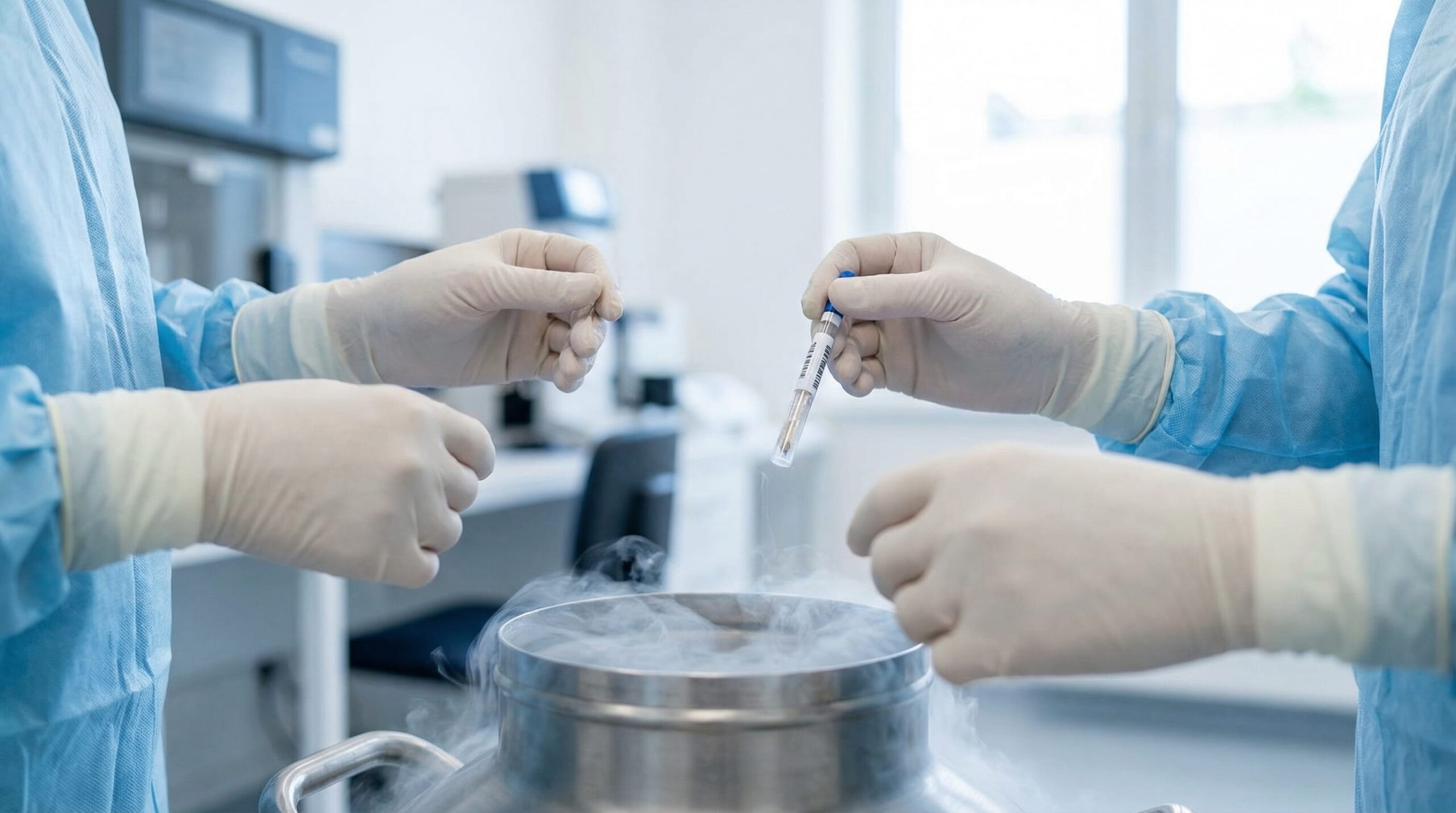
A frozen embryo is a cryopreserved embryo, usually at the blastocyst stage, day 5 to 6, stored under controlled conditions so that it can be used later. Frozen embryo transfer is called FET, meaning the transfer of a thawed embryo in a cycle different from the one in which it was obtained.
The “freeze-all” strategy means that, in a certain cycle, I choose not to perform an immediate transfer, but instead to freeze all viable embryos and schedule transfer in another cycle. In essence, we obtain embryos, keep them safely stored, then choose the optimal time for transfer.
Why we freeze embryos: the clinical benefits, in clear terms
When I talk about frozen embryos, I focus on two ideas: safety and synchronization.
Safety becomes the priority when the response to ovarian stimulation is very intense and the risk of complications, especially OHSS, increases. In such cases, freezing all embryos reduces the pressure on the body during that cycle and allows for better recovery before transfer.
Synchronization matters because embryo transfer does not mean only “a good embryo,” but also a properly prepared endometrium at the right moment. Sometimes, in the month when we obtain the embryos, the body does not offer the best implantation window. In those cases, freeze-all provides the flexibility to choose a cycle in which uterine conditions are more stable and more predictable.
In some cases, time is also needed for additional steps or for optimizing medical factors that may influence the outcome. In these situations, frozen embryos do not “delay the chance,” they organize it better.
When I recommend “freeze-all” in practice
I usually recommend the “freeze-all” strategy when the risk-benefit balance shows that transfer in a later cycle would be safer or better synchronized.

The most common situations in which freeze-all makes medical sense are the following:
- increased risk of ovarian hyperstimulation syndrome, or OHSS, or signs that the body is reacting very intensely to stimulation
- hormonal or endometrial contexts suggesting that immediate transfer would not be ideal
- situations in which preimplantation genetic testing, PGT, is planned and time is needed for results
- suboptimal endometrium on monitoring, for example appearance or thickness that does not support the best implantation window
- medical contexts in which caution and planning are essential, including when fertility preservation is being considered
At the same time, freeze-all is not a rule for every patient. If the clinical parameters are good, the endometrium is well synchronized and there are no safety reasons requiring postponement, fresh transfer may remain an appropriate choice. The criterion remains constant: what maximizes the chance under safe conditions.
What comes after “freeze-all”: the concrete steps until transfer
After the embryos are frozen, a stage follows in which the plan usually becomes clearer and more predictable. The transfer is scheduled in a separate cycle, depending on the body, monitoring and protocol.
Broadly speaking, the journey includes:
- confirmation of the number of frozen embryos and their stage
- choosing the type of endometrial preparation, natural cycle or medicated cycle, depending on the indication
- scheduling the thawing day and the transfer day
- luteal support, followed by testing at the appropriate time
From the lived perspective of the process, a description of the stages and expectations can sometimes be useful, without dramatization. In this regard, the resource on In Vitro Fertilization (IVF) – the patient experience may help normalize the questions that arise around the procedure and the period afterward.
Endometrial preparation: natural or medicated
For FET, it is possible to proceed with a natural cycle, when ovulation is predictable and carefully monitored, or with a medicated cycle, when we want more precise control of the endometrium. The choice is not “better versus worse,” but depends on cycle history, regularity, endometrial response and clinical objectives.
Embryo thawing: what it actually means
Thawing is a standardized stage in modern laboratories. In discussions, the question often arises about the embryo’s “survival” after thawing. There are objective criteria by which embryologists assess the embryo, and the plan is built around those data.
The day of transfer and the period afterward
On the day of transfer, the recommendations are simple and cautious. Some of the sensations experienced after transfer are influenced by medication or by normal bodily variations and, on their own, cannot confirm the outcome. Confirmation is made objectively, through testing at the recommended time.
Success chances with frozen embryos: why they differ from one case to another
The outcome of a frozen embryo transfer depends on several factors that interact: age at the time the eggs were obtained, embryo quality, endometrial receptivity, medical history, including uterine history, the protocol used and other individual factors.
The “fresh vs frozen” comparison can be useful in certain contexts, but it may become misleading if it ignores differences between patients and between cycles. That is why the discussion remains centered on what optimizes the chance in the specific case, not on generalization.
“You deserve to be heard, seen, treated with respect, and supported throughout your life.”


Risks, limits and myths worth clarifying
A common myth is that “if there are frozen embryos, success is guaranteed.” Frozen embryos are a valuable resource, but the outcome remains probabilistic. Another myth is that symptoms can “tell” whether implantation has occurred. Most of the time, they cannot.
There is also concern related to the duration of storage. In practice, the emphasis is placed on the quality of cryopreservation and the coherence of the plan, more than on the “passage of time” itself. At the same time, fertility and time remain real issues, especially when preserving reproductive options is being discussed. For anyone considering this direction, the text on egg cryopreservation: why time matters usefully complements the perspective.
In specific situations, the discussion about preservation becomes essential, for example when there is an oncological diagnosis or treatment that may affect fertility. For this context, the resource on oncological fertility and fertility preservation is a good starting point.
Checklist before frozen embryo transfer
A short list helps structure the discussion and reduce uncertainty:
- establishing the protocol, natural cycle vs medicated cycle, and the monitoring plan
- evaluating the endometrium, thickness, appearance and synchronization
- clarifying medication before and after transfer, including luteal support
- setting the transfer day and the plan for beta-hCG testing
- logistical questions, such as appointments, blood tests and activity recommendations
For some patients, an institutional reference point on steps and indications may also be useful. In this sense, the Genesis page on In Vitro Fertilization (IVF) offers an organized perspective on the treatment journey.
Frequently Asked Questions
What does FET mean?
FET, or Frozen Embryo Transfer, means the transfer into the uterus of a cryopreserved embryo that is thawed on the day of transfer, in a cycle separate from the one in which the embryo was obtained, so that endometrial preparation and the timing of transfer can be planned in a more controlled way.
When do you recommend the freeze-all strategy?
I recommend freeze-all when there are safety reasons, for example increased risk of OHSS, when endometrial synchronization is not ideal in that cycle or when the plan includes steps that require time, such as PGT, so that transfer can be moved to a more stable and predictable cycle.
How long can frozen embryos be stored?
Frozen embryos can be stored long-term under controlled conditions, and in practice the emphasis is mainly on the quality of cryopreservation and the clarity of the usage plan, in compliance with the applicable legal and administrative framework.
Does thawing embryos reduce the chances?
In modern laboratories, freezing and thawing are standardized procedures, and most viable embryos do well after thawing. Still, the real chances depend on the full picture, meaning the embryo, the endometrium, the protocol and the medical history, not on one single stage.
What is more suitable: FET in a natural cycle or in a medicated cycle?
The choice between a natural cycle and a medicated cycle is made individually, depending on cycle regularity, predictability of ovulation and endometrial response, because the goal is the same: correct synchronization of the endometrium with the embryo stage on the day of transfer.
Can the result be “guessed” from symptoms?
Most of the time, symptoms after transfer cannot confirm implantation, because they are often influenced by progesterone or normal bodily variations, and confirmation is made objectively through beta-hCG at the recommended time.
How many embryos are transferred and how is that decided?
The number of embryos transferred is determined on a personalized basis, taking into account age, embryo quality and reproductive history, with the aim of achieving a healthy pregnancy and reducing as much as possible the risk of multiple pregnancy when it is not necessary.
What options exist for remaining frozen embryos?
For remaining frozen embryos, the options may include keeping them for a future transfer or continuing cryopreservation. This is a decision that deserves time, counseling and a clear discussion in relation to the family plan and the legal framework.

The role of Dr. Andreas Vythoulkas in a plan involving frozen embryos
In these situations, my role is to turn medical data into a simple and correct decision: when the right time for transfer is and which protocol makes sense for each patient’s body. When I recommend freeze-all, I do so because, in that context, I consider that safety and synchronization can increase the real chance without adding unnecessary risks.
I focus on three things: clarity of the plan, predictability of monitoring and the balance between efficiency and caution. Cryopreservation is not an “extra step” for the sake of technology, but a tool that can help when used with medical logic.
In certain particular situations, the preservation strategy goes beyond frozen embryos and includes options such as eggs, sperm or ovarian tissue, including in oncological contexts. From an institutional perspective, these options are also described on the Genesis page about cryopreservation, eggs, sperm, embryos, ovarian tissue, and for oncofertility there is also the dedicated resource on fertility preservation for oncology patients.
Talk to me about
Frozen Embryos
Sources
- ASRM – Best practices pentru vitrificarea ovocitelor și embrionilor (Committee Opinion)
- ASRM – Prevenția și tratamentul OHSS (Guideline)
- ESHRE – Guideline: Ovarian Stimulation in IVF/ICSI (pagina oficială)
- RCOG – Ovarian hyperstimulation syndrome (OHSS) – informații pentru pacient
- CDC – About ART (include crioprezervarea ovocitelor și embrionilor)
Similar Articles

Sonohysterography (Sono-HSG): When I Recommend It, How Much It Costs and What We Do After the Result

When Basic Investigations Are Not Enough in Infertility
