

When the question “which tests should I do?” comes up, it is tempting to look for one universal answer, a standard “package” that fits everyone. In practice, female fertility evaluation is not built on a single result, but on a combination of analyses, the timing of collection and interpretation in the context of the cycle, medical history and transvaginal ultrasound.
In the lines below, I use the term “female fertility test” the way most people use it: the initial evaluation that includes hormonal testing and basic investigations. I will describe what usually belongs in the starter package, how to choose it correctly and which traps are worth avoiding.
What a “Female Fertility Test” Actually Means
In everyday language, a “female fertility test” can mean anything, from a set of hormone tests to a complete workup, sometimes ordered without a clear plan. From a medical perspective, it is more useful to see it as a process: you gather relevant information, confirm ovulation and ovarian reserve, evaluate the uterus and ovaries and decide whether additional steps are needed.
Also, a “female fertility test” should not be treated as an absolute “good” or “bad” result. Some values have different meanings depending on age, cycle day, symptoms and ultrasound findings. Ideally, the set of tests is chosen to answer a few simple questions:
- Is ovulation happening?
- What does ovarian reserve look like in the context of age?
- Is there a common hormonal cause that is easy to correct?
- Are there ultrasound findings that change the plan?
The Basic Package: Tests That Clarify the Picture Quickly

A good initial package should be comprehensive enough to avoid important “gaps,” but also clear enough to be interpreted correctly. Two services are often worth placing from the start in a logical order: hormonal tests and transvaginal ultrasound.
Day 2–3 Hormones (FSH, LH, Estradiol)
These are often included in fertility testing because they provide information about the hormonal axis at the beginning of the cycle. Depending on the values and context, they can guide discussions about reserve, ovulation or other imbalances. A key detail is that collection on day 2–3 matters precisely to avoid confusing interpretations.
Practically, this block is especially useful when a “female fertility test” is started without a clear idea about timing. If the day is not appropriate, results can look “abnormal” even when they are not.
AMH (Ovarian Reserve)
AMH is one of the most searched results when people look for a “female fertility test,” because it seems to offer a clear number. In reality, AMH describes ovarian reserve, not egg quality and not the exact probability of pregnancy in a given cycle.
AMH makes sense when correlated with age and ultrasound (antral follicle count, AFC). A low value may require a different pace for next steps, while a high value can appear in contexts such as polycystic ovary syndrome. That is why fertility testing should not be reduced to AMH alone, no matter how popular it is.
Progesterone (Confirming Ovulation)
Progesterone is often used to confirm whether ovulation occurred. The classic trap is timing: “random” progesterone testing is one of the most common sources of confusion in any “female fertility test.”
In general, progesterone is measured about 7 days after ovulation, not on a universal fixed day. This means cycle length matters. In some situations, correlating with ovulation monitoring is more useful than a single isolated measurement.
TSH (± FT4) and Prolactin
TSH is an essential marker in the initial evaluation because thyroid dysfunction can influence ovulation and cycle regularity. In practice, TSH becomes a key reference point in fertility testing, especially when cycles are irregular, there are suggestive symptoms or there is thyroid history.
Prolactin is also relevant, but it is worth remembering it can be influenced by stress, sleep and certain medications. Sometimes a properly repeated test is more valuable than quick conclusions from one draw.
Transvaginal Ultrasound (Uterus, Ovaries, AFC)
Ultrasound complements the hormonal side because it shows what blood tests cannot: uterine anatomy, polyps, fibroids, ovarian appearance suggestive of PCOS, antral follicles (AFC) and more. For many people, ultrasound is a core part of a “female fertility test” because it significantly reduces the risk of incomplete interpretation.
How to Choose the Package Correctly: Common Scenarios (Without Over-Testing)
A good package does not mean “as many tests as possible.” It means the right tests, at the right time, with an interpretation that leads to a clear decision.

Scenario 1: Relatively Regular Cycle, No Special Symptoms
Usually, a set of fertility tests (day 2–3 hormones + AMH + TSH ± prolactin) plus ultrasound is enough. If ovulation is unclear, properly timed progesterone can complete the picture.
Scenario 2: Age 35+ or Longer Time Trying
In this scenario, ovarian reserve (AMH + AFC) weighs more in planning. Depending on results, treatment options, including In Vitro Fertilization (IVF), may be discussed earlier, without assuming automatically that IVF is the only path.
Scenario 3: Irregular Cycles or Suspected PCOS
In addition to the basic package, investigations related to an androgen and metabolic profile may be considered depending on context, because these can explain infrequent ovulation. Here, ultrasound and history play a major role. A “female fertility test” done as a standard checklist can miss the relevant pieces.
Scenario 4: Significant Pain, Suspected Endometriosis, Intermenstrual Bleeding
In this framework, targeted ultrasound and clinical evaluation drive which investigations make sense. Hormonal fertility tests without a solid imaging step can lead to incomplete conclusions, because some causes are primarily anatomical or inflammatory, not strictly hormonal.
“You deserve to be heard, seen, treated with respect, and supported throughout your life.”


When to Do the Tests: Timing Matters as Much as the Test
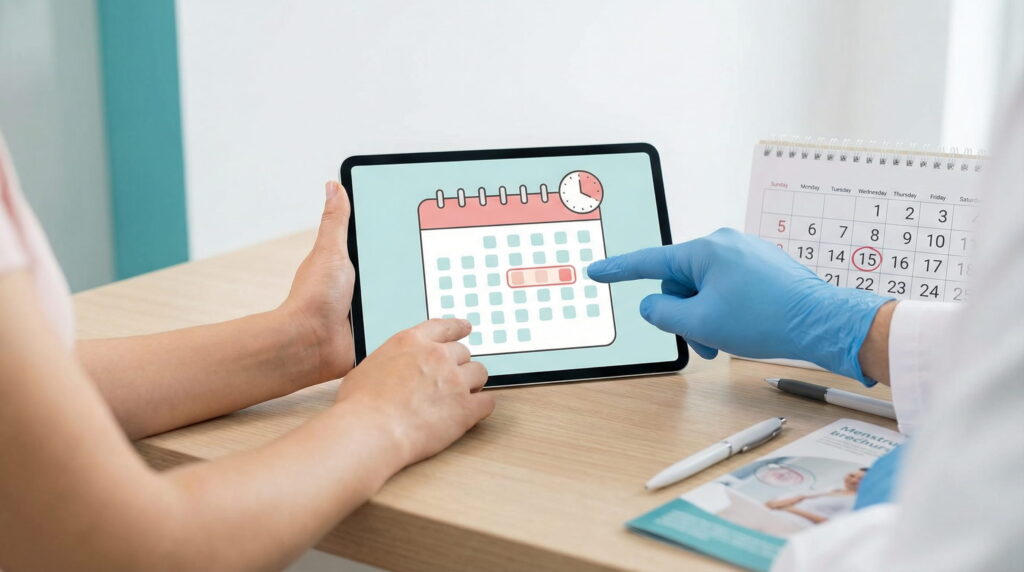
A large share of confusion around a “female fertility test” comes from blood draws done on the wrong days or interpreted without reference to the cycle.
- FSH/LH/estradiol: typically on cycle day 2–3
- AMH: more flexible timing, but interpretation still depends on context
- Progesterone: in the luteal phase, about 7 days after ovulation, not “day 21” for every cycle
- TSH: not strictly cycle-day dependent, but consistency and collection conditions matter
- Ultrasound: useful in the right window depending on the goal (baseline evaluation, monitoring, etc.)
Where there is uncertainty, it is healthier to repeat a test correctly than to draw firm conclusions from a result taken “on a random day.”
How to Interpret Results Without Rushed Conclusions
In practice, a value “outside the interval” does not automatically equal infertility. Laboratory ranges are general, and fertility is an area where context is decisive. That is why a “female fertility test” becomes truly useful when it answers the question: “What does this result change in the next plan?”
Sometimes, a set of values suggests ovulation is rare. Other times, ovarian reserve is lower than expected for age. Other times, a thyroid factor (TSH) should be corrected before additional steps. In some cases, the pathway may include additional counseling, including genetic counseling, not as a general rule, but when there are indications (family history, recurrent pregnancy loss, previous results, etc.).
What Comes After the Basic Package
After a correctly done “female fertility test” (tests + ultrasound + interpretation), next steps differ case by case. Sometimes optimizing ovulation or monitoring is enough. Other times, additional investigations are needed, for example evaluating the fallopian tubes if there are suspicions.
When advanced options are considered, patient experience and how the process is navigated matter. For those who want to better understand the stages, reading about IVF from the patient’s perspective can help, alongside medical explanations, in order to build a realistic, not purely technical, picture.
In particular situations, egg donation may also enter the discussion, but it is not a conclusion drawn from a single analysis and not a “standard recommendation.” It is a decision that appears only after a complete evaluation and a careful discussion of alternatives.
Frequently Asked Questions
What does “female fertility test” mean in the initial evaluation?
Usually, it includes hormonal tests and ultrasound, with focus on ovulation, ovarian reserve (AMH/AFC) and common factors such as TSH and prolactin. The real value comes from correlating them, not from a single result.
Does low AMH mean pregnancy is no longer possible?
No. AMH describes ovarian reserve, it does not guarantee or exclude pregnancy. Interpretation depends on age, ultrasound (AFC) and context. Sometimes low AMH changes the pace of decisions, it does not “close” options.
Does TSH influence fertility?
It can influence ovulation and cycle regularity, and in certain contexts it also matters for pregnancy evolution. That is why TSH is often included in a “female fertility test,” but interpretation depends on personal history and other parameters.
Should progesterone be done on “day 21” for everyone?
No. “Day 21” only makes sense for typical 28-day cycles. In general, progesterone is measured about 7 days after ovulation, and the correct timing differs depending on cycle length and ovulation timing.
Does estradiol (estrogen) matter in the evaluation?
Yes, estradiol is often interpreted together with FSH/LH, especially early in the cycle. It can offer clues about hormonal dynamics and how the other values should be read.
Can tests be done if there were recent contraceptives or hormone treatments?
It depends on the treatment type and the time interval. Some results can be influenced and may require postponement or cautious interpretation. In many situations, ultrasound and history clarify what makes sense and when.
Is transvaginal ultrasound necessary in a “female fertility test”?
In many cases, yes, because it provides anatomical information and ovarian details (AFC) that blood tests cannot substitute. It can also identify findings that change the plan (polyps, fibroids, PCOS appearance and so on).
When do you move from tests to options like IVF?
When evaluation shows that chances through simpler methods are reduced or when time becomes an important factor (for example age). The decision is not made from one test, but from the overall picture: AMH/AFC, ovulation, uterus and ovaries on ultrasound, history and duration of trying.

The Role of Dr. Andreas Vythoulkas in Female Fertility Testing
In fertility evaluation, a list of tests is not enough without clinical reasoning that links results to a concrete decision. My role in these situations is to treat a “female fertility test” as a set of information that must be put in order: timing of collection, the correlation between AMH, TSH, progesterone, estrogen and ultrasound, then defining the steps that make sense for each case.
When an institutional perspective and details about treatment options are needed, materials from Genesis Athens can complement the picture, including In Vitro Fertilization (IVF), a comprehensive IVF guide or core services such as hormonal tests and transvaginal ultrasound. Ultimately, the right direction is not the most “popular” one online, but the one that fits medically, logically and realistically with the data of each situation.
Talk to me about
Female Fertility Tests

Sources
- ASRM – Testing and interpreting measures of ovarian reserve (Committee Opinion, 2020)
- ACOG – Evaluating Infertility (FAQ pentru paciente)
- ACOG – Infertility Tests and Treatment (video educațional)
- ESHRE – AMH testing (explicație oficială, 2024)
- NICE – Fertility problems: assessment and treatment (CG156 – Recommendations)
Similar Articles

How Intimate Infections Can Affect Fertility

In Vitro Fertilisation (IVF) | The Patient Experience
